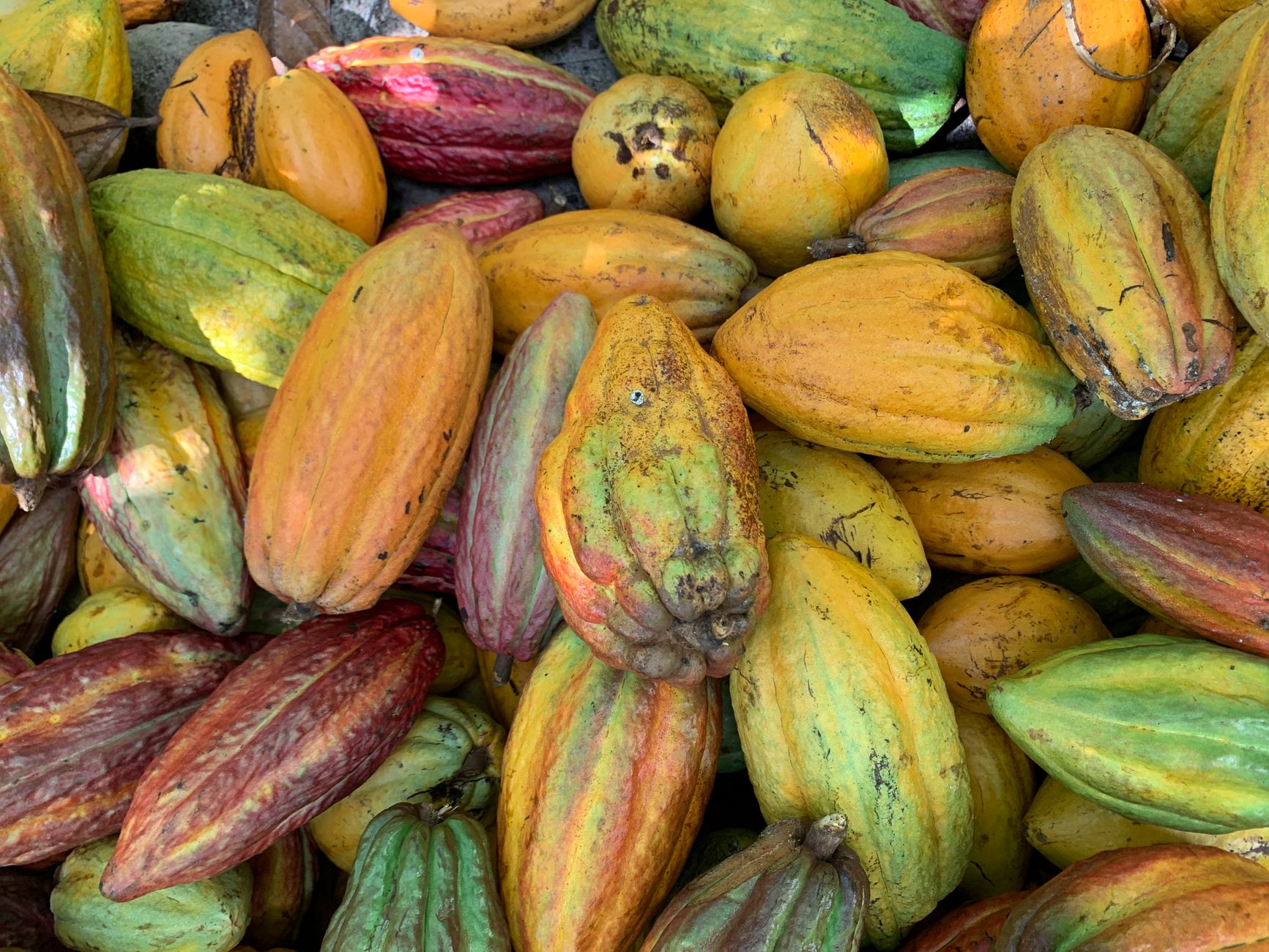
What left La Convención for Lima fitted into crates, and in the crates there was not a single cacao bean.
There was paste, in blocks of a hundred grams and of a kilo. There were chocolate bars, from the mildest to the darkest. There were nibs. There was powder, in sealed bags. Three hundred and nineteen Matsigenka families sent the capital everything that can be made from chuncho, except chuncho.
Leonid Herrera, who manages the cooperative, said what they were going for: recognitions that would back the quality of the product. They already have two gold medals. They are going for more.
It makes more sense looking at the price. The bean that a year ago exported at more than ten dollars a kilo is paid half that today, and in one month it dropped below four. When the commodity stops paying, what is left to sell is the name: chuncho, from Cusco, from these valleys and not others.
But a name is not sold: it is proven. And proving it means a dossier — national and international tasters, sensory characterisation, field sampling in the areas still missing, a geographic border drawn with rigour.
The families are going to manufacture that proof. In Peru, when the proof is ready, the title to the denomination of origin is not in their name.
What follows is who owns a name that somebody else demonstrated.
Scene reconstructed from documented behaviour and territory; sources at the foot of the article.
The Signal
On 4 March 2026, in the province of La Convención, Cusco, the Mesa Técnica de Café y Cacao (the regional coffee and cacao technical roundtable) formally opened the process for the Denomination of Origin of Cacao Chuncho Cusco. Taking part were the municipalities of Echarati, Quellouno, Kumpirushiato and Megantoni, the Provincial Municipality, the Huadquiña, Aguilayoc, José Olaya and Alto Urubamba cooperatives, the Agencia Agraria La Convención of GERAGRI, DEVIDA, INIA, UNDP, SENASA and Swisscontact. Nobody signed anything. The roundtable adopted agreements.
The two central agreements describe work still to be done. One is to form “a national and international technical team of tasters and specialists” that “will complement the sensory and technical characterisation of the product, strengthening the scientific basis of the dossier”. The other is to go out into the field “to complete the sampling in areas not yet evaluated, ensuring a rigorous geographic delimitation”. Neither exists yet: the team is to be formed, the sampling was contemplated.
To claim the name of a crop the Matsigenka domesticated before the Incas, foreign tasters will have to be brought in to certify its flavour and the hillside forest walked with sampling sheets. The ancestral fact does not count as proof: it has to be turned into a dossier. As of August 2026 nothing has been filed with INDECOPI.
The Context
The dossier opens the year the price collapses. Peruvian cacao exports went from US$10.81 per kilo between January and April 2025 to US$5.54 in the same period of 2026, almost 49% less, with April at US$3.98 and 65% below the January 2025 peak of US$11.32. The bean fell from 61% to 36% of exported value; derivatives rose to 64%. When the commodity stops paying, what is left to sell is the origin.
Four months later, with no reported connection to the roundtable, 319 Matsigenka families from Koribeni, Alto Urubamba and Ivochote took their cacao to the Salón del Cacao y Chocolate in Lima: 100% pure paste, chocolates from 50% to 80%, nibs and powder. Not a single bean. “We are going with the expectation of obtaining new recognitions that back the quality of our product,” said Leonid Herrera, general manager of the Cooperativa Agraria Cafetalera Alto Urubamba, whose K'ampaq brand already holds two Gourmet de Oro awards.
That release does not mention the denomination of origin. It is signed by DEVIDA, the Peruvian State's anti-drug agency, and it frames cacao as an alternative development crop: these are “319 families betting on lawful activities and reducing their vulnerability to drug trafficking”. Two disconnected facts, from different months, that light up the same mechanism.
In 2017 that same cooperative received the collective mark “Kall Kakao”, Resolution No. 07138-2017/DSD-INDECOPI. A collective mark does not require proving origin: it registers a name. A denomination does. That is the leap from 2017 to 2026.
The Reading
The edge is not in the story, it is in the statute. Article 88 of Legislative Decree 1075 says it without hedging: “The Peruvian State is the holder of Peruvian denominations of origin, and authorisations of use shall be granted over them” — our translation of the Spanish text of the norm. Producers do not obtain the title but an authorisation which, under Decision 486 of the Andean Community, lasts ten renewable years (article 210), is granted by INDECOPI or by a regulatory council (article 208), and reaches only those who “carry out that activity within the geographic zone delimited according to the declaration of protection” (article 207).
From that follows something that is not opinion: no Peruvian denomination of origin belongs to an indigenous community, and the regime does not allow it. The Matsigenka will produce the proof that the crop is theirs: they will pay for the tasters and walk the areas not yet evaluated in order to draw the boundary. The title will stand in the name of the State. And whoever falls outside the line they themselves drew loses the right to the name.
There is a strong counter-argument. The technical dossier is a universal requirement, and in this province it has already been done: Café Machu Picchu-Huadquiña is the seventh Peruvian denomination, granted in 2011, with 600 producers from the Cooperativa Huadquiña — the same cooperative that sits at the roundtable of 4 March 2026. Peru also already has a cacao denomination, Cacao Amazonas Perú, from 2016. None of this is unprecedented. What the argument does not explain is who holds the title.
Two holes, declared. The finding of 4 March has a single documentary origin, the agricultural agency GERAGRI, and the report that carries it contains no attributed statement. The second is more telling: the product whose value they are about to certify has no public price, and there is no verifiable 2026 figure for its premium over common cacao. Nor is there any published schedule of fees for the authorisation of use.
The Pattern
When an ancestral food turns premium, the knowledge passes through a conversion: from inherited practice to certifiable document. It costs money, it requires outside experts, and it produces a border. The border protects those inside, excludes those outside, and is drawn by the very people who will not own the name afterwards. Peru has eleven denominations of origin — the latest, Orégano de Tacna, from January 2024 — and chuncho would be the twelfth. The Peruvian regime makes explicit who keeps the title, but the structure is not Peruvian: it happens to any collective knowledge that enters a system designed for individual or state holders.
The roundtable has been meeting for ten years: it was created by Regional Ordinance No. 103-2015-CR/GRC.CUSCO, of December 2015. In September, Quillabamba hosts FICACAO 2026 with chuncho as its axis; that announcement does not mention the denomination either.
Each link supports a claim made in this piece. Open to check.
- Revista Lombriz · 2026 — the Mesa Técnica de Café y Cacao opens the process for the chuncho cacao denomination of origin, 4 March 2026
- FreshFruit · 21 May 2026 — Peruvian cacao export price falls from US$10.81 to US$5.54 per kilo between January-April 2025 and the same period of 2026
- gob.pe / DEVIDA · 2026 — 319 Matsigenka families from Koribeni, Alto Urubamba and Ivochote take their cacao to the Salón del Cacao y Chocolate in Lima
- gob.pe / MINCETUR · 2017 — collective mark “Kall Kakao”, Resolution No. 07138-2017/DSD-INDECOPI
- WIPO Lex · Peru's Legislative Decree 1075, article 88 — the Peruvian State is the holder of denominations of origin
- WIPO Lex · Decision 486 of the Andean Community, articles 207, 208 and 210 — authorisation of use for ten renewable years
- gob.pe / INDECOPI · 2011 — Café Machu Picchu-Huadquiña denomination of origin, Peru's seventh, with 600 producers
- Marcasur · January 2024 — Orégano de Tacna, the eleventh Peruvian denomination of origin