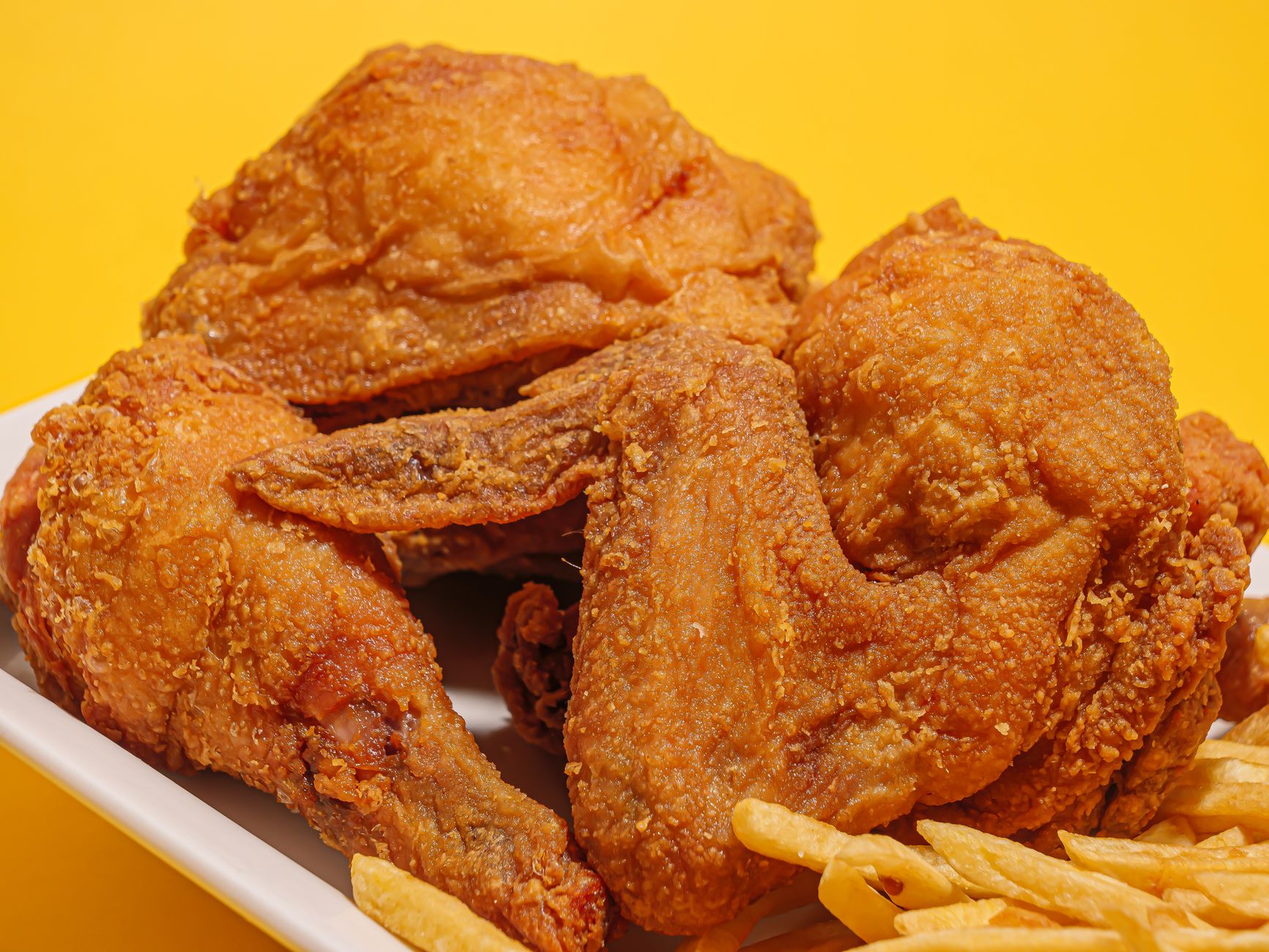
Some rituals aren't up for negotiation. Mine begins with a packet.
All my life, fried chicken in Colombia came with honey. It's not a whim: it's the silent pact between salty and sweet that trained our palate, the sidekick that turns any old lunch into the lunch you remember. The honey isn't an extra; it's part of the emotional recipe. You don't order chicken with honey: you repeat a gesture you learned as a child.
That's why I noticed it instantly. It was at Frisby — at the Viva Palmas location and also the one in Palmagrande, in Envigado; later I confirmed the same thing was happening across the whole chain. I ordered the usual: a whole chicken with fries. I bit in, and something rang false. The chicken wasn't to blame: it was the same as always. The mistake was in the honey. I turned the packet over and read, in fine print, the verdict: "honey-flavored dressing." It wasn't honey. It was an imitation with a borrowed name, served inside the same ritual, as if no one would notice.
I felt cheated. Swindled. And ever since, I bring my own honey — 100%, guaranteed — to the chicken table.
I tell this because that tiny betrayal reveals something big about how brands understand what they sell. They believe a recipe belongs to them. They're wrong: a recipe that has entered someone's memory is no longer entirely theirs. They own the product; we own the meaning. And when they optimize the product without seeing the meaning, they aren't saving money: they're expropriating a memory from us and calling it efficiency.
What a brand thinks it sells
Every food chain changes. It's a law of survival: prices move, supplies run short, competitors arrive with discount wars and you have to respond. A brand that doesn't adapt dies. So far, no complaint.
But adapting has a limit almost no one names: some recipes are untouchable, no matter what. Not out of stubbornness, but because they stopped being product and became rite. Chicken with honey isn't on the menu: it's in a country's memory. And what lives in memory can't be managed with the same spreadsheet you use to manage a margin.
That's the underlying misunderstanding. A brand thinks it's managing a SKU — a reference, a cost line, a prep time. In reality it's managing a meaning we lend it. The SKU is theirs; the meaning is ours. They can optimize the first as much as they like; the problem starts when they believe optimizing the first doesn't touch the second.
It does. And when it touches it unwittingly, it always commits the same mistake in three different ways. I lived all three.
Cut one: killing the answer you already had
Frisby is one of those brands you don't choose: you inherit it. Born in Pereira in 1977, it became — without asking permission — part of the country's emotional landscape: the chicken of birthdays, of the long road trip, of the Saturday that felt special. I had a cult favorite there: a chicken drenched in their own BBQ sauce, made in-house, unusual at a time when almost no one talked about BBQ. I rarely saw anyone else order it. It was mine precisely for that reason.
One day I went and it was gone from the menu. I asked, I complained, I demanded explanations. The answer was straight out of the manual: someone, somewhere, had given the order to drop it. It wasn't profitable. It ate up logistics time. It meant more process. My flagship product vanished without anyone asking me — because, of course, who asks the owner of the meaning when the SKU gets cut?
Years passed. Chains arrived with aggressive prices, seasonal marketing, flavors that change every month. And then, almost like a revelation, the sauce came back. Today it didn't just return: it multiplied into variations and worked its way into half the menu. A hit.
What do you call that? It wasn't a stroke of luck. It was an answer the brand already had stored in its own history and hadn't known how to read. They had the ammunition against the threat they didn't see coming — and years earlier they had executed it for failing to understand it. The mistake wasn't pruning the menu. The mistake was failing to tell a dish from a heritage.
Cut two: when the owner changes, the soul changes
My second loyalty was expensive. In school I saved all week for a single weekend luxury: El Corral's Italian burger. I remember it with a lover's precision — sesame bun, real beef, mozzarella, and a sauce with pesto, sun-dried tomatoes and a purée of fresh tomato, deeply Mediterranean; and on top of it all, parmesan cheese. It looked simple, but the flavor was one of a kind. It wasn't a burger: it was a little Mediterranean trip a kid from Antioquia could afford once a week.
One day it disappeared too. And when I went to understand why, I found the same logic as the chicken, now with a structural explanation. El Corral, founded in Bogotá in 1983, was sold in 2014 to Grupo Nutresa for some 830 billion pesos. From then on, the customers' conversation changed tone. One comment I read summed it up without mercy: "once it was sold to an economic conglomerate, the love of the craft gets set aside and they focus only on maximizing profits… a smaller menu and worse quality."
It's perception, not an audit — worth saying. But when thousands repeat the same perception, the perception is the product. Nobody tastes an earnings statement: you taste a burger and decide whether it's still yours.
Here the cut is different from Frisby's. It wasn't a brand that misunderstood itself: it was a brand that changed hands and, with the hands, changed purpose. What was a craft to the founder is an asset to the new owner. And an asset gets squeezed; a craft gets cared for. The difference is felt in the mouth before it's understood in the head.
Cut three: the fraud of the ritual
Let's go back to the packet, because the third cut is the quietest and, for that very reason, the worst.
Discontinuing a product is, at least, honest. The dish is gone, you see it, it hurts, you decide whether to stay or leave. There's grief, but there's truth. The honey is another kind of thing. No one took anything away. The packet is still there, the same size, with the same old gesture. Only now there's no honey inside: there's "honey-flavored dressing." The rite stayed intact; what filled it was emptied out.
That has a technical name. It's not shrinkflation — reducing the quantity and keeping the price: it's skimpflation, reformulating with a worse ingredient and charging the same. And it also has a legal outline. Real honey is protected: in Colombia, INVIMA reserves "bee honey" for what meets the regulation, and the FDA and the international Codex say the same. That's why the packaging doesn't lie in the fine print — it says "honey-flavored dressing" because it legally cannot say "honey." The brand complies with the rule. And even so it deceives, because the deception doesn't live on the label: it lives in the ritual.
That's the point that separates this cut from the other two. BBQ-era Frisby failed to understand itself; El Corral changed owners. But relabeling the honey is something else — and it hurts more because it's committed by Frisby, the Saturday brand, the very one that once gave me back my sauce: a conscious decision to sustain the gesture while emptying the substance. It's asking the customer to keep believing in a rite the brand has already stopped honoring.
That's why I do the only thing I have left: I bring my own honey. One hundred percent, guaranteed. And when the customer starts bringing from home what the brand promised, something has broken that no promotion can fix.
The pattern: three ways to lose the memory
Lined up, the three cases stop being anecdotes and become a pattern. Three different ways of committing the same mistake: confusing what's being managed.
At Frisby, the brand didn't understand itself — it killed an answer it already had because it could only read it as cost, not as meaning. At El Corral, a change of owner changed the purpose: what was a craft became an asset, and the asset gets optimized without sentimentality. With the honey, the brand kept the gesture and emptied the content: it kept the rite and betrayed the substance.
Not understanding, selling, emptying. The same wound, deeper each time. And in all three, a common denominator: the decision was made looking at the spreadsheet and not the table. Someone optimized a cost line without asking what memory they were touching — because in no org chart is there a box that says "this belongs to our customers, not to us."
That's the pattern I care to name: the optimization that severs the brand from the memory it manages. It's always done in the name of efficiency. And it is, almost always, the silent beginning of irrelevance.
To be sure: what the brand would say in its defense
It would be dishonest not to give the other side the floor, because it has weighty arguments.
First, survivor's bias. I celebrate the return of the BBQ because it came back and triumphed; but I don't see — no one sees — the hundred products that were discontinued for perfectly good reasons and that no one misses. Memory is a cheat: it keeps the win and erases the failure. For every recipe that deserved to come back, there are dozens that deserved to die.
Second, rationalizing the menu isn't cruelty: it's survival. An infinite menu collapses the kitchen, drives up inventory costs and slows service. Pruning is part of the craft of lasting. No brand survives by keeping everything out of sentimentality.
And third, nostalgia lies. The flavor "from back then" is sweetened by the years, not by the recipe. Sometimes what changed wasn't the product: it was me.
Granting all of that, the thesis doesn't collapse: it sharpens. Because I'm not asking brands to keep everything — I'm asking them to know what they're cutting. Frisby's sin wasn't pruning: it was pruning blind, without telling a SKU from a rite. Rationalizing is legitimate; rationalizing without that map is amputating without a diagnosis. And with the honey the survivor's argument doesn't even apply: nothing was pruned there, the gesture was falsified. No efficiency redeems that; there's only, barely, a customer who learns to distrust.
What's coming: memory as competitive advantage
There's an irony that crowns all of this. While these brands neglect themselves on the inside, they fear the threat from outside. Frisby lives it literally: since 2024 it has fought a legal battle in Europe to keep a Spanish company from taking its name. It's the classic nightmare — a stranger stealing your brand. But the most dangerous threat doesn't come from a court in Alicante: it's signed in a boardroom, the day someone decides the honey can be "honey-flavored dressing." External theft gets sued; internal hollowing-out gets applauded as savings.
And here I return to the question that opened it all: do brands own their products, or does the customer have a right over their experience? The answer is already being written at the table. When I bring my own honey I'm not an eccentric customer: I'm a signal. The consumer who starts bringing from home what the brand promised has become their own supplier of authenticity — and that's the first crack in loyalty.
What's coming plays out right there, and it has already begun to show. The next cycle won't be won by the chain with the lowest cost or the leanest inventory, but by the one that understands its recipe is heritage with a pact, not a cost line. The signal has dated precedents: Coca-Cola took just 79 days, in 1985, to bury its "New Coke" and bring back the original formula as "Coca-Cola Classic"; and in July 2025 McDonald's brought back the Snack Wrap — which it had discontinued in 2016 because it "slowed down the kitchen" — after years of customers demanding it. The same logic that killed my BBQ sauce, correcting itself in slow motion and in full view of everyone. More of that is coming: a wave of "recipe restorations," "original" and "classic" editions, brands trying to buy back with marketing the trust they spent optimizing. Some will pull it off. Others will discover, too late, that memory can't be bought back.
Because in the end the math is simple, and optimization forgets it: you can squeeze the margin of every dish down to the last drop, but if no one comes back to the table, there's no return that makes it all worthwhile.